back to colour

Recent experiments in the dye studio!

folded fabrics in shades of brick orange and greenish brown

This is a cutch dyebath I recently made with Lisa of asil (link: asil.ca). We split the dye into two vats and added iron to one of them hoping for a good range of browns. The result from the straight cutch was predictable, a range of reddish brick tones (seen on cotton and linen in the above photo). The iron vat didn’t give the same warm chocolatey brown shade I achieved last year, when I dyed a piece of linen to make my partner some brown pants. Instead we got this almost charcoal gray brown drab, the result of going too heavy on the iron. I’m pretty much a master at this point of going too heavy on the iron, if this kind of clumsiness were the sort of thing over which one could claim mastery. You can see the too-iron-rich brown on both cotton and linen above.

fabric floating in deep yellow dye in a steel pot

I’ve been having lots of success with this brew lately, and have finally hit upon an easy and abundant source of the swampy olive tones I so crave. This is a 50/50 vat of ground pomegranate skins and turmeric. I read about adding pomegranate to turmeric to improve its lightfastness in the guide to natural dyes published by Maiwa, a great resource and the place where Lisa and I buy a lot of our dyes (link: MAIWA). They didn’t mention proportions so half and half is what I’m trying. This vat just keeps on giving, exhaust after exhaust, and the colour is just WOW.

After the first load of glorious gold fabric came out, I reheated the exhaust dye and threw in this collection of cotton yarns, which all started out either white or very pale gray and had been gunked up with a myrobalan tannin in the mordanting process and a dip in iron water to produce dirty gray tones.

skeins of undyed cotton yarn in shades of yellow and gray

As I had hoped, the iron present in the yarns permeated the dye vat and shifted the whole thing to a murky olive green.

fabric floating in olive green dye in a steel pot

The resulting yarns, due to the variations in their iron content, came out a lovely range of the swampiest greens I’ve yet achieved. Here you can see them drying along with a set of the same yarns, pre-dirtied in the same manner and then dyed with indigo. This will probably be the bulk of my summer knitting as there’s enough yarn here for three warm weather sweaters.

skeins of olive green and indigo yarns hanging on a drying rack

After the yarn came out of the dyebath it looked like there was still a fair amount of colour, so I heated it up again (exhaust #2 now) and dyed another load of fabric. Here are the resulting fabrics together in the rack:

gold and brown fabrics hanging in a drying rack

And the fabrics after drying, but before their final wash (which I try to put off for a couple of weeks if I’m not in too huge a rush to sew something). From the top, with iron on cotton, on handkerchief weight linen that had previously been dyed very lightly with madder root (red), two pieces of secondhand linen duvet cover that started out oatmeal colour, and the unadulterated turmeric-pomegranate gold on the same duvet linen, and on cotton bedsheet.

pomturm

I’ve since done a second round of this same dye bath and managed to get loads and loads of weird acid greens and paler sludgy olives. Pictures soon!

white noise in a white room

a carved linoleum block sitting next to a graphite rubbing of the block on paper, with carving tools scattered around

Here’s something fun I’ve been working on recently. It’s a lino block of one repeat of a brocade pattern for printing on fabric.

I needed some white on white, or nearly white, brocade fabric for a quilt series I’m working on (for an exhibition in September, more on that later). It’s not the exact pattern but it meant to represent the white brocade wallpaper in my maternal grandmother’s living room. This particular pattern is taken from a certain style of gold brocade drapes from the 1970s that must have been everywhere, based on the sheer volume of them my partner and I used to find in thrift stores in the 90s. Those were our Society of Creative Anachronism years, and I still have my glorious Russian shuba (full length overcoat with “fur” trim) made from this, as well as a beautiful but unfinished court sarafan hanging in my closet. My ulterior motive for using this pattern for my quilt project is that I will be able to print other fabrics with the block later on, in particular a set of old fashioned pinch-pleated drapes for our bedroom.

For now, though, I’m printing it in white on a variety of not-white fabrics, mostly thrifted cotton bedsheets, that I’ve made not-white by boiling in coffee (the absolute easiest and best smelling way to make white just a little less white) and a more grayish not-white by adding tea and a bit of ferrous sulfate to the coffee.

a brocade pattern printed in white ink on off-white fabric

This was my first attempt, with janky registration and a hole in the fabric that I printed right over, and yes, this piece will probably end up in a quilt, hole and all. I’m not at all worried about the registration for this project, although I’m quickly getting the hang of getting the block lined up. There are things I could have done in the planning stages to make registration easier, but oh well. I’m kind of a messy printer at the best of times.

I didn’t do anything to clear out the chatter on the block, and I’m pretty happy with how it fills up the space between motifs in the fabric. Accidental marks are so often the best kind of marks, in printmaking.

Here it is printed on the pale gray where the contrast is actually enough to be able to make it out on screen. The paler fabric is visible on the right, a level down in the drying rack.

pale gray and white brocade fabric lying on a steel drying rack

perpetual dyebath

I decided to give over one of my dye pots to seeing what happens if a dye is kept going and added to over time. I started with a little pile of leftover dyestuffs, 100g each of coreopsis flowers from the garden, osage chips, sappanwood chips, buckthorn, and eupatorium, that I had used to make extracts for printing pastes. Cooking up those leftovers yielded a lovely soft orange.

pd01
Here’s some wool roving, linen, and cotton simmering in the vat.

pd01indigo
Here’s that wool roving overdyed with indigo; the deep orange spots are where the cheesecloth bag of coreopsis was nestled up against it.

On the second day I added a teaspoon of lac extract. It made the orange deeper but left tiny red dots of undissolved dye everywhere.

pd02
Enjoy this camera reflection in a reddish vat.

On the third day I added some henna powder and a cheesecloth bag of dried, shredded eucalyptus leaves along with a bit of spent logwood dyebath to top up the liquid. I don’t recommend combining henna and eucalyptus unless you like your studio to smell foul for days. But it shifted the dye back to a nice light orange.

pd03

Here’s a photo of the 3rd day fabric in the drying rack. I treated half the fabric in 2% WOF ferrous sulfate and shifted it to that dull olive below, which got me so excited I dumped the rest of the ferrous solution into the dye vat and stripped my dress off and tossed that in too. The dress didn’t get dark enough and had to be dyed one more time, and now my perpetual dyebath is tainted with iron. Whoopsie!

pd3fabric

Here’s that 4th iteration of the vat with the iron added and the dress and other fabric simmering.

pd04

And here’s the fabric from the first four days. From top: the original orange; orange deepened with lac extract and tiny red spots of undissolved lac (not sure until it’s been washed out whether those spots are permanent); a different orange from a smellier vat; smelly orange dipped in 2% ferrous sulfate; olive drab from ferrous added to the vat.

pdresults1to4

Now this vat will be for mucking up and saddening too-bright colours, until enough of the iron is exhausted that I can start shifting the vat back to happier colours.

blue sketchbook, pages 34 & 35

page34-35

Fungal growths, lace medallions, and a mountain engraved with an ode to The Master. Black ultrafine Sharpie, various coloured markers, white gel pen.

The verso page is drawn over the bleed-through from page 33.

“The Master” is my name for a drink I used to like, which was originally introduced to us as a shot at a Mexican restaurant in Atlanta that our friends Bob and Sandy used to take us to. The bartender claimed to have invented it and called it “Dub-Dub”. I’ve never been interested in chugging alcohol just to get drunk so I sipped it instead and it was GOOD. The name sucked though so I renamed it when I started making it at home, The Master because it’s two parts tequila and one part Grand Marnier, basically a margarita without the lime. A little bit of literary humour. Anyway we rarely drink anymore despite having a daunting collection of good alcohol displayed in our dining room, on that old gutted player piano we made into a bar cabinet. When you try this drink use the best tequila you can afford and serve it on the rocks. Oh, The Master!

drinks diary february 16 2014

sb14-2-16

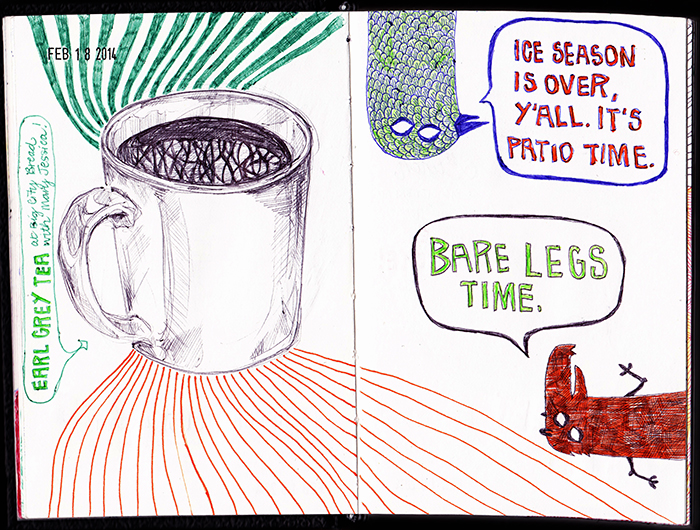
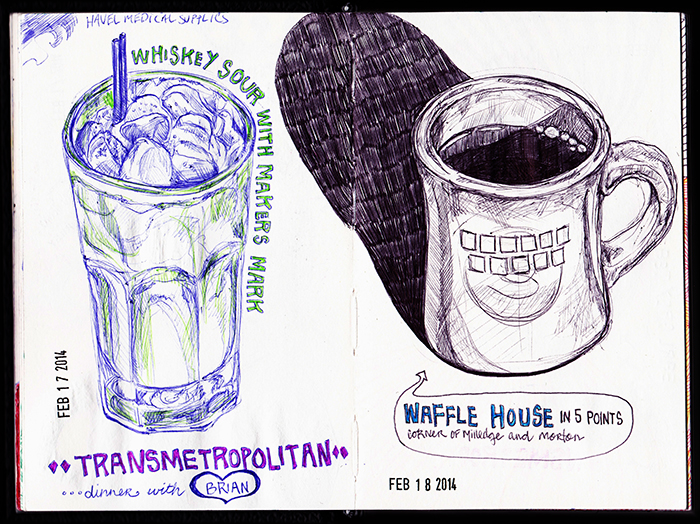
Breakfast room coffee in a Best Western in Richmond, KY. My approximation of the cover of a book about guns that a guy next to us was reading. It’s obvious I don’t know anything about guns by how I can barely draw a representation of them. I’m totally okay with that.

All the colours of Zebra F-301 ballpoint pen. Yee-haw!

sb14-2-16-2

Later the same day, lunch at La Fiesta in Lake City, TN, a favourite place for us to stop on this highway. And lunch the next day at The Grit (RIP) in Athens, GA, with Jenny (High Energy Knits if you remember the old knit blog days) and her son.

Green and blue ballpoint pen and a bit of marker.

books i read in 2025

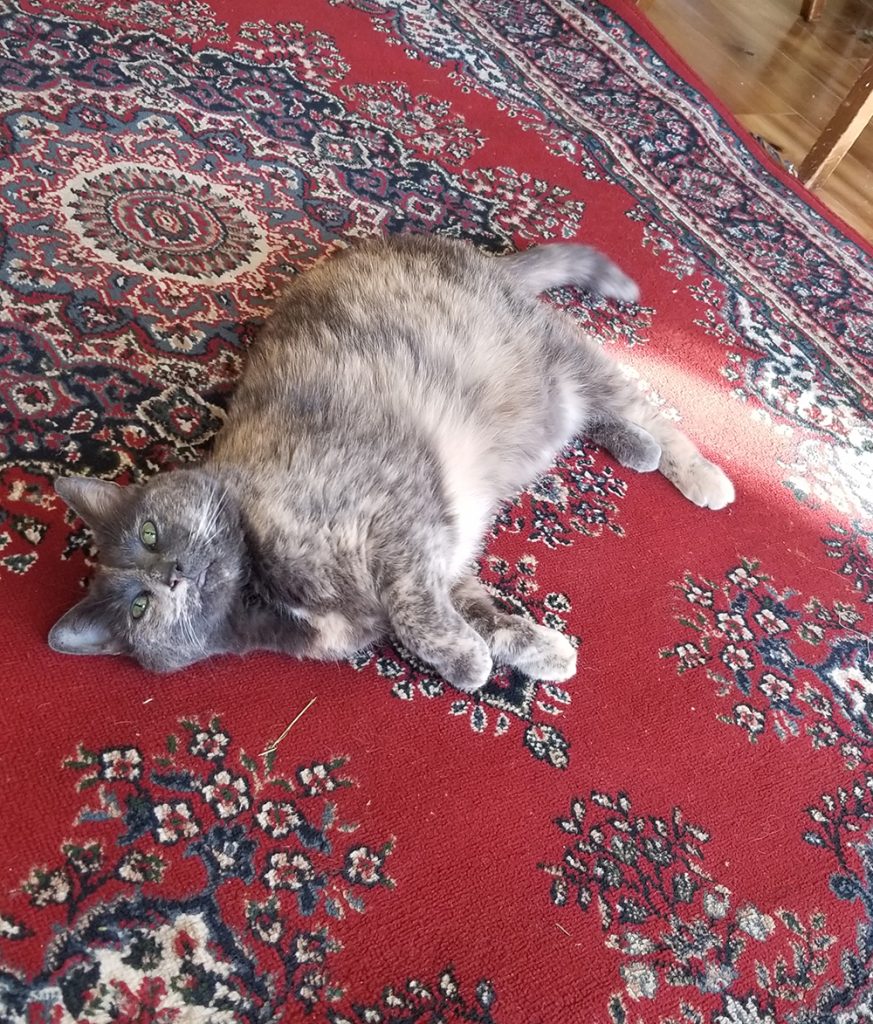
Last winter I decided to make a change to my morning routine, taking my after breakfast coffee up to the bedroom couch (the preferred couch of our elderly cat) and reading a book instead of looking at social media or working on textile projects like I used to do. It gives both me and the cat a calmer start to the day, and means that this year I read a good deal more books than any other year since I started keeping track.

This morning I permanently deleted my one remaining social media account. Yes, the calendar is arbitrary, but still it’s nice to start off a new calendar year with a feeling of freedom.

Okay, here are the books:

1. Annie Dillard, The Writing Life
2. Richard Wagamese, Keeper ‘n Me
3. Todd Strasser, Fallout
4. Thea Lim, An Ocean of Minutes
5. Nicole Chung, All You Can Ever Know
6. Jasmin Gyuh, Gokudols
7. Octavia E. Butler, The Parable of the Sower
8. Drew Hayden Taylor, Motorcycles & Sweetgrass
9. Jamil Jan Kochai, 99 Nights in Logar
10. Edith Wharton, The Custom of the Country
11. Alice Walker, The Color Purple
12. Jules Verne, Journey to the Centre of the Earth
13. Jonas Jonasson, The 100-Year-Old Man Who Climbed Out the Window and Disappeared
14. Chuang Hua, Crossings
15. Heather Young, The Distant Dead
16. M. G. Vassanji, The Magic of Saida
17. Emma Donoghue, Room
18. Jorge Luis Borges, The Aleph and Other Stories
19. Carlos Ruiz Zafón, The Shadow of the Wind
20. Ayşegül Savaş, Walking on the Ceiling
21. Salman Rushdie, The Enchantress of Florence
22. Elizabeth Hay, A Student of Weather
23. Cathy Marie Buchanan, The Painted Girls
24. Okey Ndibe, Foreign Gods, Inc.
25. Mona Awad, All’s Well
26. Edward Dorn, Slinger [Gunslinger]
27. Michael Ondaatje, In the Skin of a Lion (re-read, first read 25 years ago)
28. Timothy Findley, The Wars
29. Anne Rice, Violin
30. Waubgeshig Rice, Moon of the Turning Leaves
31. Eduardo Mendoza, The City of Marvels
32. Yu Miri, Tokyo Ueno Station
33. Louise Erdrich, The Mighty Red
34. Neel Mukherjee, Choice
35. Lori Lansens, The Mountain Story
36. Vendela Vida, And Now You Can Go
37. Vincent Lam, The Headmaster’s Wager
38. Jonas Jonasson, Hitman Anders and the Meaning of It All
39. James McBride, Deacon King Kong
40. Kate Beaton, DUCKS
41. Thomas Hertog, On The Origin of Time
42. James McBride, The Heaven & Earth Grocery Store
43. Edwidge Danticat, Everything Inside
44. Rebecca Solnit, A Field Guide to Getting Lost
45. Zora Neale Hurston, Their Eyes Were Watching God
46. Carol Shields, Small Ceremonies
47. Rebecca Solnit, Orwell’s Roses
48. Haruki Murakami, Norwegian Wood
49. Anne Rice, Interview With The Vampire
50. Heather O’Neill, The Girl Who Was Saturday Night
51. Amal El-Mohtar and Max Gladstone, This Is How You Lose the Time War
52. Heather Abel, The Optimistic Decade
53. Osamu Dazai, No Longer Human
54. David A. Robertson, The Theory of Crows
55. Yasutaka Tsutsui, Paprika
56. Richard Wagamese, Indian Horse
57. Chinua Achebe, No Longer at Ease
58. Satoru Noda, Golden Kamuy
59. Joshua Barkman, Life After Life
60. Edwidge Danticat, The Dew Breaker
61. Chido Muchemwa, Who Will Bury You?
62. Ursula K. LeGuin, The Dispossessed
63. Haruki Murakami, Colorless Tsukuru Tazaki and His Years of Pilgrimage
64. Chanda Prescod-Weinstein, The Disordered Cosmos

drinks diary 13 & 15 february 2014

sb14-2-13

Tea at Milk Coffee Bar (RIP) with Carly, which we ended up throwing into a to-go cup when the stand up comedy show we didn’t know was happening (stand up comedy being a thing I would never subject myself to by choice) got super racist.

Then Waffle House coffee in Florence, KY as we drove down to visit Athens, GA, where I went to grad school.

Ballpoint pen and marker.

shorty

20250923_093705

Five weeks ago today my sweet friend Shorty died.

These are the last photos I took of her, back in September when we were still enjoying our mornings together on the front porch.

sept23shorty3

Towards the end of the summer she had started climbing into my lap if I wasn’t quick enough to dole out the nuts, and trying to crawl into my pocket to get them herself. We’d reached a level of trust that even allowed me, just a few weeks before she died, to reach out and flick a bit of dried leaf off her head without so much as a flinch from her.

20250923_093347

I don’t know what happened to her. One minute she was fine, running up and down the fence, wiggling her silly little stump of a tail, and taking walnuts from my hand like always. Four hours later my partner found her dead in the alley with no signs of trauma.

She’s buried in the backyard at the base of this little log feature I made in July out of some cut off pieces of utility pole the workers left in the alley when our poles were replaced.

signal-2025-06-27-17-43-37-074

the housening: backyard edition

It took me all summer to complete this job I had expected to have finished by the end of May. It’s the only big job I managed to finish all summer. But just look at how pretty my shed is.

20251101_132526

When we went to look at rust paint colours, we assumed we’d be choosing from the traditional range: red, cyan, Tonka toy yellow, John Deere green. But we found out something very exciting: when you buy the Home Hardware store brand rust paint, you can have it tinted any colour. As in, any colour from the wall of paint chips for the regular paint. We were like kids in a candy shop.

Here’s how it looked in late June, with just the front and sides finished. That pasty non-colour on the door, with fake wood grain, is what the whole thing used to look like.

shedpartway

The painting seemed to take forever, because due to all the bending and crouching involved (and my ageing body and bad back) I painted the shed one side at a time. Having to plan for, and wait for, adequate stretches of dry weather dragged the project well into fall. I started with the hard part, the narrow space between the shed and the fence, and nearly passed out in there from breathing the paint fumes in that hot, tight space. Fun!

I stand at this window every single day feeling pleased with myself, and enamoured with these colours. Please don’t look at my unhemmed curtains; that’s a winter job.

20251106_154534

Here it is in the first snowfall of the year:

20251109_102841

And the next day, with more snow. I grew up in a much snowier place than I live in now, and my family made fun of me when I sent them this picture.

20251110_090115

And here’s what it looks like now, a bright flash of colour in an otherwise bleak urban winter landscape, under what is, most years, about as much snow as we normally get here.

20251207_103809

We left a gap in the fence at the back of the shed, which faces onto our alleyside parking, so that the alley cats would still have their familiar back door into the yard. Right behind the rose of Sharon is a kitty-sized gap. There’s now a row of four baby roses of Sharon here to make the kitty door more private.

signal-2025-09-08-15-41-24-685

a new dress (sort of)

For a few years now I’ve kept a practice of making myself a new dress for my birthday. This week as I was finishing up Cobbled Bodice Attempt #5 on a dress by a careless and sloppy designer I both love and hate (Tina Givens, IYKYK), it occurred to me that I should be making myself a new dress to celebrate my Gramma’s birthday instead (or in addition to). My Gramma was a professional sewist, making and altering things for people right up to the day she died. She gave me the skills and the confidence to make my own clothes. She taught me how to read and use a sewing pattern while guiding me through making the most fiddly and ridiculous shirt I’ve ever sewn, with cuffs and buttonholes and an asymetrical closure and an incredible ruffle that ran all the way up the front opening and around the collar. She bought me my first sewing machine, and bequeathed me her last one, which I still use. She would have turned 99 today.

As I should have expected, the bodice fix I was attempting didn’t work out (um hi, it took me five tries to realise it’s not the bodice that’s the problem). That dress is back on the sewing room floor, destined to become a skirt or rags, and I’ll make a whole post about my struggles with Tina Givens and her beautiful yet deeply crappy patterns another day. Fortunately, I had another dress nearly finished so I had something far better and more beautiful to wear today than that utter failure.

meandthecaptain

Pattern details: like most of what I make, this dress is a pastiche. The mullety two-layer skirt is from the Metamorphic Dress by Sew Liberated (pattern link: Metamorphic Dress). I had at first made this using the same bodice pattern I used for my thesis dresses, an apron-ish style I still love but the shoulder straps of which tend to fall down constantly from my narrow shoulders. I’m working my way slowly through my closet and remaking everything that’s not perfectly comfortable, the majority of which have that irritating strap problem. I adapted this new bodice from the Orchard Dress by Helen’s Closet (pattern link: Orchard Dress). I wore it to the public library knitting club today and the straps didn’t fall off once!

The top layer fabric is pieced together from large flour sack towels that I dyed with tea and screenprinted with all of my favourite motifs: cartoony flowers, clusters of floating arches, twisting segments of warped spacetime, and layers of gritty monoprinting blocked out with paper cutouts. The bottom layer is my old standby, the SCA’s favourite chemise cotton from the Bleachery in Aurora, Illinois, dyed a softly mottled pale olive tan with goldenrod flowers and iron water.

The Captain, whose pose I’m trying to copy here, is wearing my Gramma’s ribbon full of pins won in the Senior Games, along with my Granddad’s steam show hat full of badges.