future blues

Today I refreshed the indigo vat with a new jar of starter solution, and while it was reducing I took today’s projects to be dyed out to the backyard to document the “before”.
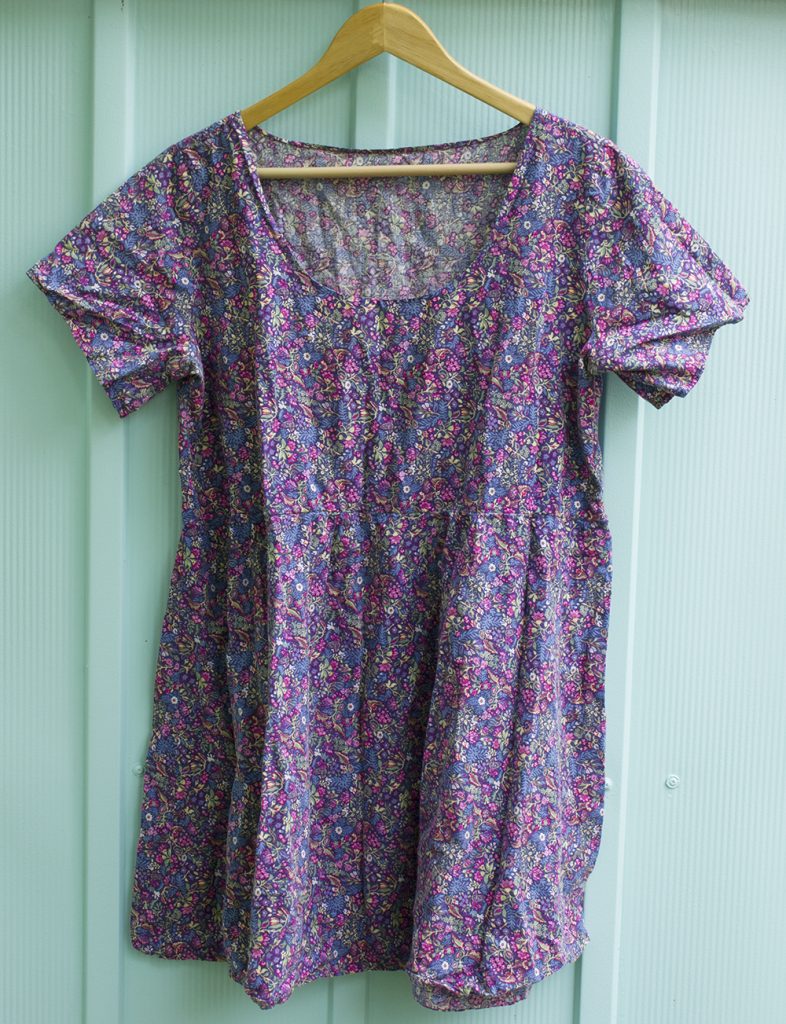
a loose cotton dress with short sleeves, in a small blue and pink floral print, hanging against a seafoam green steel garden shed

The first is this old dress from a former life. I made this some time in the early 1990s and despite its ill fit I wore this thing A LOT. I even wore it to someone’s wedding although I can’t remember whose. It was ankle length then, with long sleeves, but I eventually shortened it. A couple of years ago I found it up in the attic. It’s going to get overdyed with indigo, then I’ll cut away all the fabric leaving just the seams behind. These seams will be stitched down onto the Two Sisters portrait quilts to “draw” their garments. It’ll make more sense, I hope, once the pieces start coming together.

Is a garment made in the early 1990s considered “vintage”? Because it feels awfully weird to have a vintage dress I made myself.

The second piece going in the indigo today is this tie-dye cotton shawl, a project I worked on over several weeks at my sewing circle. It’s a beautiful, very large cotton mull shawl from the Maiwa shop (link: Maiwa natural dyes) that I mordanted with myrobalan tannin and alum before deciding to use indigo, which doesn’t require a mordant but that’s okay because the parts that don’t get dyed will be this soft myrobalan yellow instead of bright white.
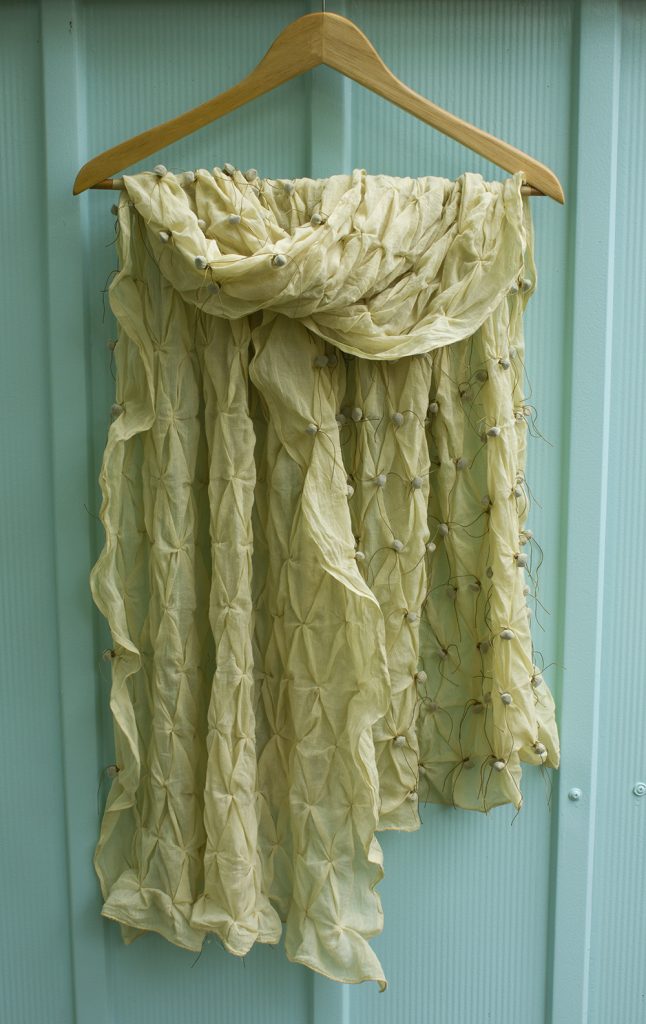
a pale yellow shawl hanging against a seafoam green steel garden shed

I marked out a staggered grid over the whole shawl and tied a tamarind seed in at each grid point. I kept track of the time while doing it; this is 10 hours, 20 minutes of tying seeds into cloth.
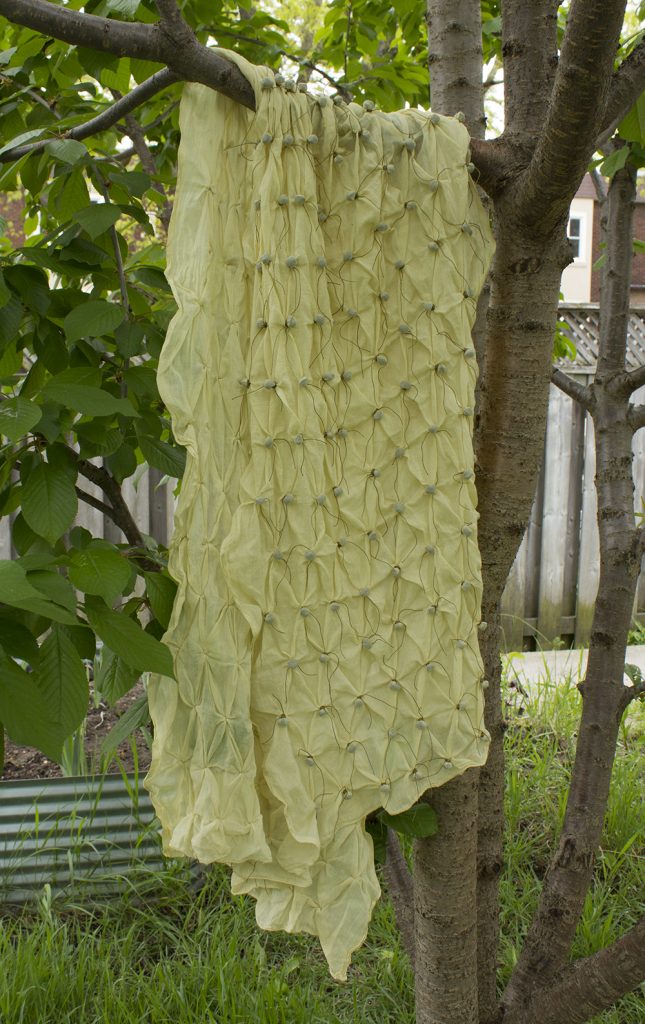
a pale yellow shawl hanging in a cherry tree

This piece looks so beautiful just tied like this, so I took lots of pictures. Here’s a closeup of the tied in seeds:
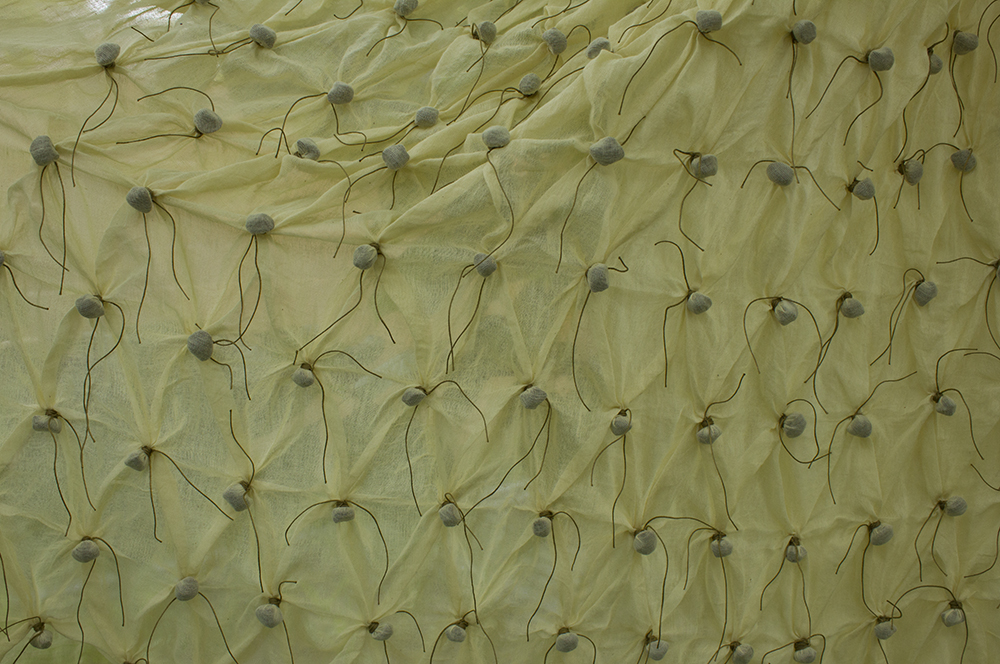
a panel of pale yellow fabric with seeds tied into it in a grid pattern

And here’s the back side. I love how the staggered grid pulls it in to look like some kind of glorious combination of smocking and sashiko.
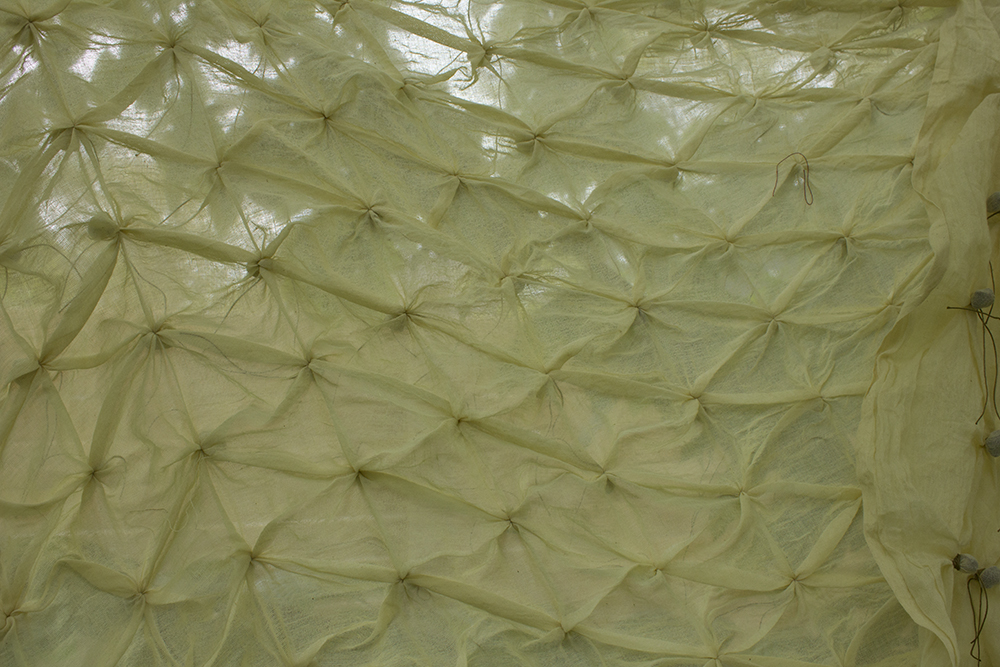
pale yellow fabric with seeds tied into it

red transom

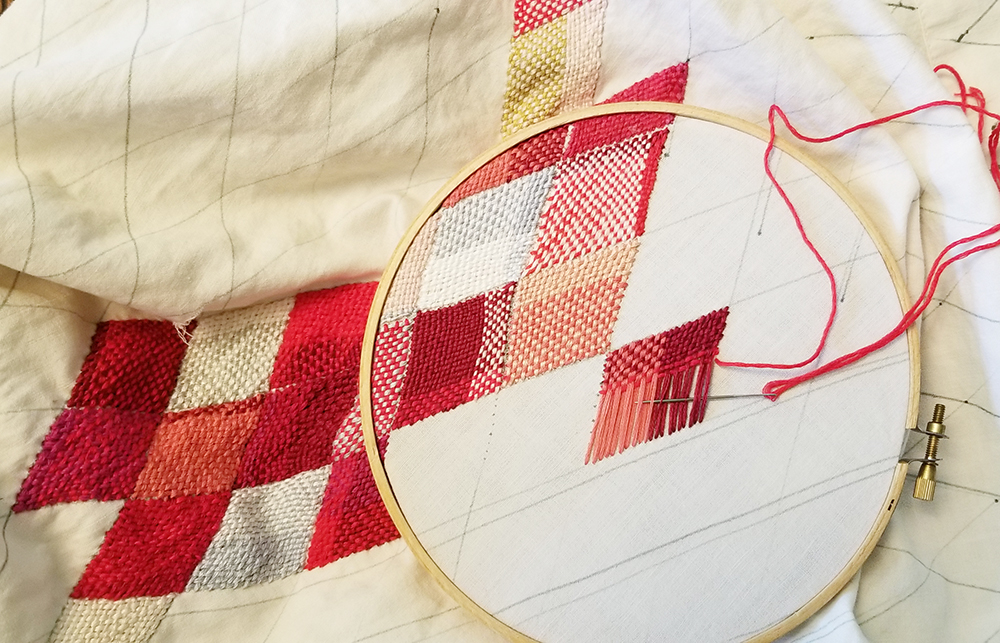
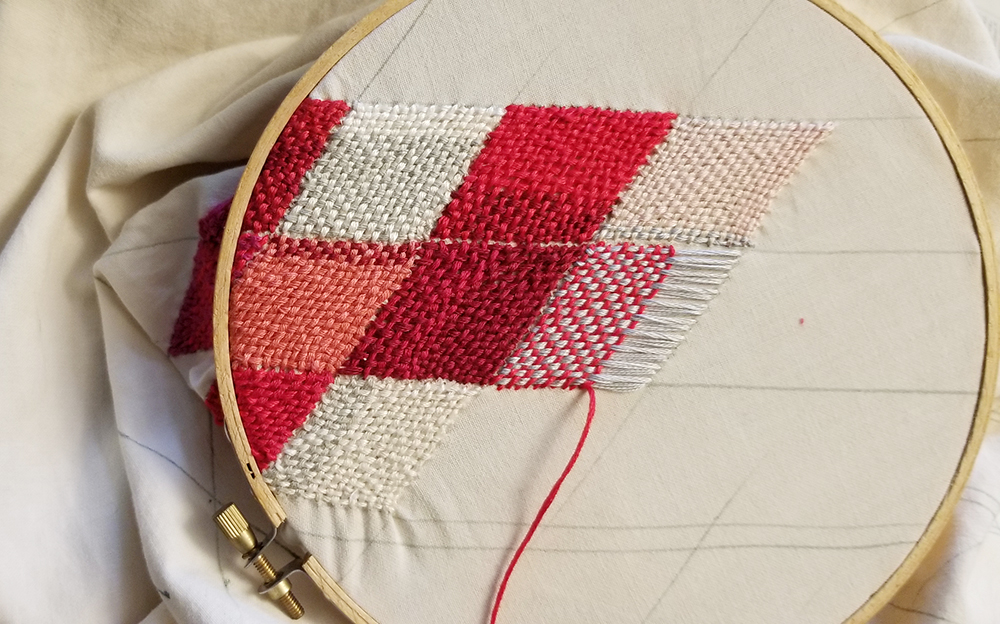
white fabric in an embroidery hoop with woven stitched diamonds in shades of red

These diamonds are worked like darning, but employed as embroidery on cotton fabric. I’m using embroidery floss, which as you can imagine is a real pain in the ass. I’m constantly having to pull out and redo rows of weft because of failing to get the needle over or under a single strand of the 6-strand floss. I think the final product will be worth it, but wow, this is tedious. I work at it a little bit several days a week and it’s going to take months to complete.

white fabric in an embroidery hoop with woven stitched diamonds in shades of red

This is part of a six quilt series I’m working on for my upcoming two-person exhibition with Lisa Sylvestre (link: asil) in September. The works are, in part, about memory and comfort, as all quilts are in a way about memory and comfort. These quilts will depict a particular space in a particular room, drawn and stitched from memory in different states of abstraction. I’ll write a lot more about these over the coming months.

This panel of diamonds is just one method I’ll use to illustrate a red transom window in that remembered room. It’s going to be the slowest part of the whole project, which is why I’m working on it every day. This will eventually be pieced together with other fabrics (including the linoblock printed brocade, which is the wallpaper in that room of memory) and quilted along the lines that separate the diamonds. The real life red transom did not have a diamond pattern; it may have had a floral diapering pattern or it may have been plain red glass, but I can’t remember and every time I try to call up the image in my memory it shifts, which is all part of how memory works and also why the window will be drawn many different ways in the quilts. Some, but not all, of these will have portraits. All of them will have plants.

two sisters

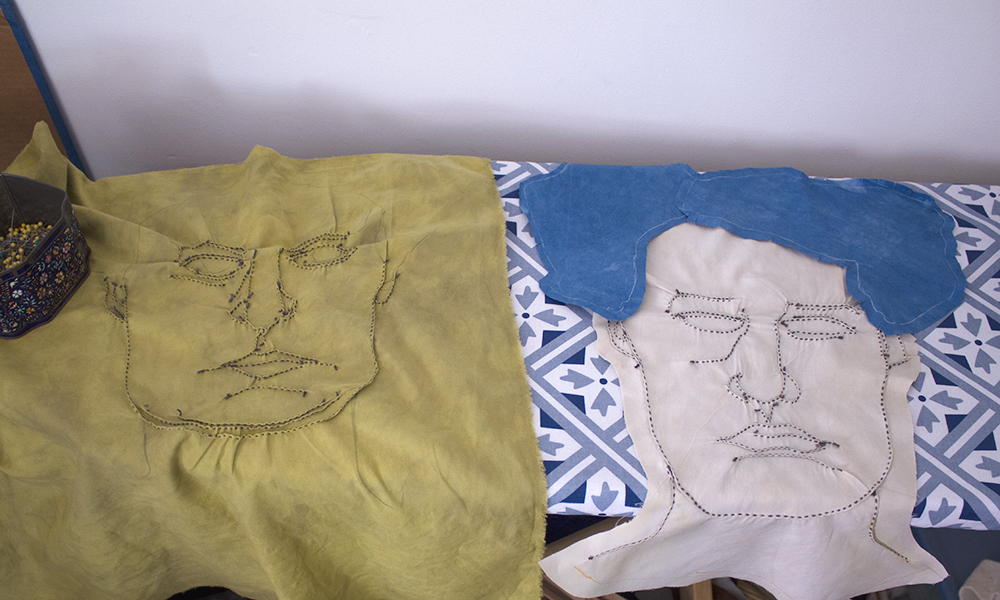
hand stitched portraits in progress, lying on an ironing board

I’m finally back to working on those stitched portraits I was playing with a while ago, making up a couple of small quilts to test out some processes I’m hoping to use in some bigger work later this year. These two small studies will be part of an upcoming exhibition to accompany a jazz festival at Mackenzie Hall this summer. The larger quilt works that these are serving as practice for will be exhibited in September. I’ve got a lot of quilting to do this spring and summer!

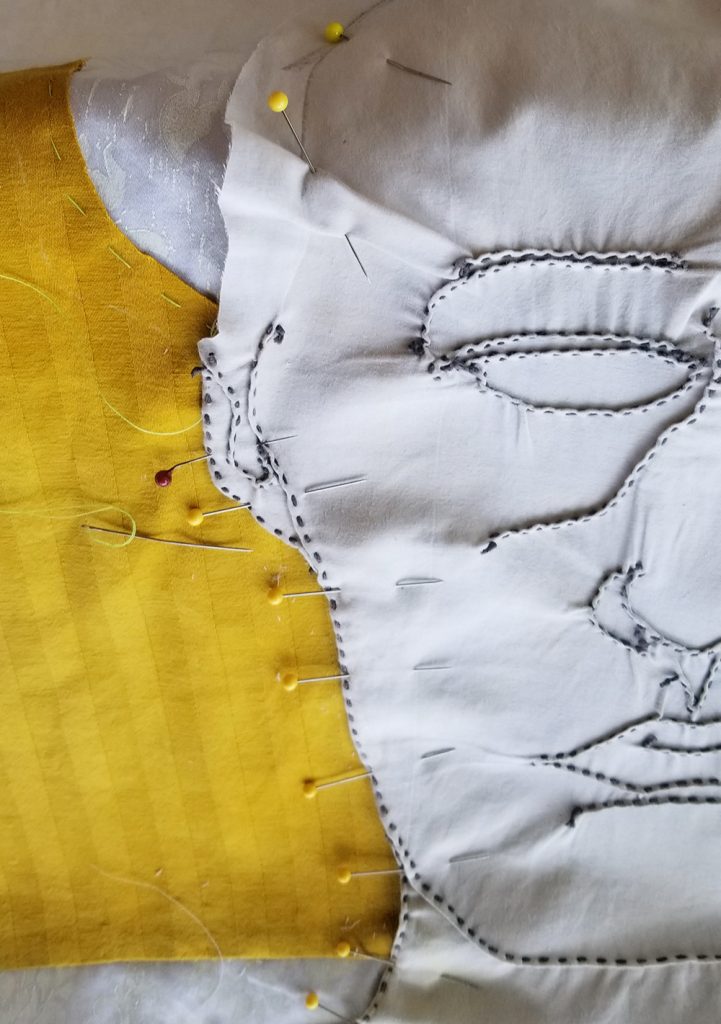
yellow and white fabric pinned together with a stitched drawing of half a face showing

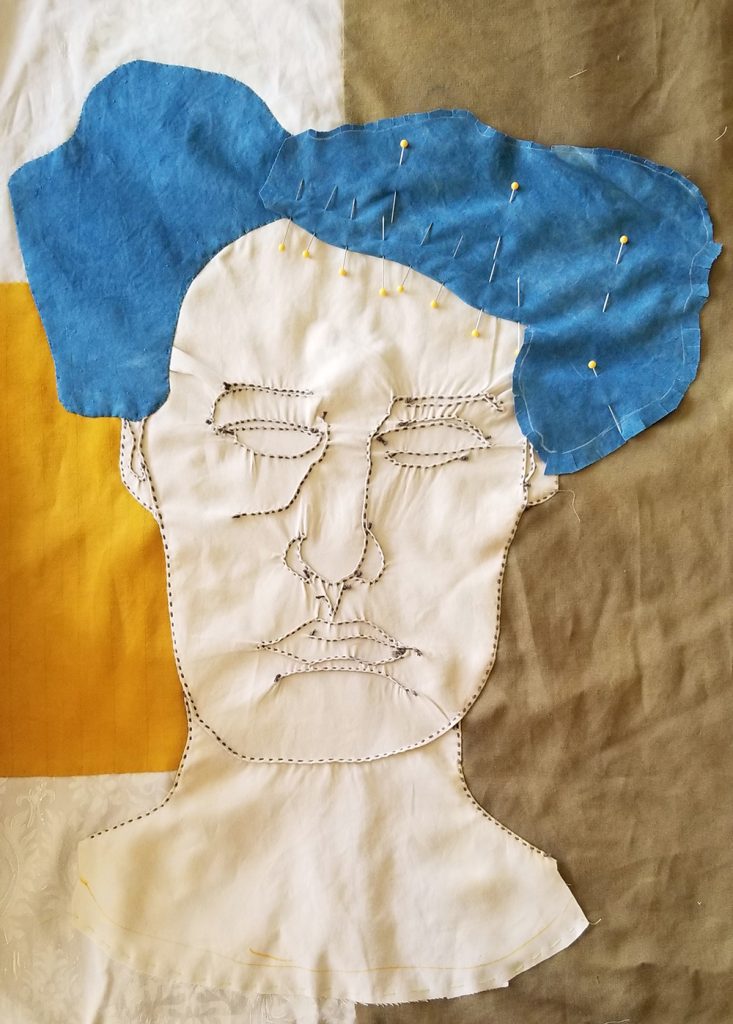
I’m hand stitching the portraits onto a colour blocked background of various naturally dyed cottons and some of the white-on-white brocade I printed recently. These will be composed like formal portraits, and each figure will be holding a potted plant. No conceptual reason for the plant, it’s just an exercise in making stitched plant portraits, again practice for those larger works to come, for which there IS a conceptual reason for the plant. Phew.

a hand stitched portrait in progress, white face with blue hair on a yellow and olive background

Despite the blue hair, this isn’t a self portrait.

pintucks + pleats

On Monday afternoon I took an online workshop on the Quilty Nook (link: The Quilty Nook) with the amazing quilting teacher Heidi Parkes (link: Heidi Parkes) focused on adding texture to your quilts using pintucks and pleats. It turned out to be immensely fun and also maybe has helped me get unblocked on a new line of work I’ve been struggling to find focus with. I immediately realised the potential of this technique for drawing, and Wednesday evening I took a stack of fabric to life drawing club and made some loose contour portraits to try combining my drawing with stitching.

Here’s my first test piece, worked in red sashiko thread on a piece of thrifted cotton bedsheet dyed with tea and iron. This is the pintuck side:

pintuck5

And here’s the pleat side, with its wonderful clots of pooling red in all the tight little corners and cluster points:

pintuck51

Exciting, right? I’ve got around ten more sketches of faces on fabric to work with, plus a few hands and feet. I’m looking forward to seeing where this new method takes me, and of course am already bursting with too many ideas.

blue sketchbook pages 16 & 17

page16-17

Howdy friends, it’s been a while!

Here’s another spread from that blue sketchbook. Ballpoint pen, white gel pen, and colour markers of varying quality. Those floating rings reminded me of meat, mac, & cheese, something with which I had a sick fascination as a kid but which I have never eaten (because, ew).

“Peking Duck in Lotus Land” was the title of a painting by an unknown Chinese artist, one of a small collection that were for sale in a gallery I used to work at in the late 90s. The painting depicted a line of ducks zigzagging along a winding river between giant lotus plants and I desperately wanted it but couldn’t afford it because I was in my 20s and working several part-time jobs. I still regret not buying it but, oh well.

hbd lithoman

senefelder

It’s that time of year again when we here at Levigator Press celebrate the birthday of Alois Senefelder, born November 6, 1771, playwright, actor, connoisseur of girls, inventor of lithography. My pretend boyfriend.

Listen to a podcast about Senefelder and his achievements at this link: Engines of Our Ingenuity no. 791: Senefelder and Lithography

Read Senefelder’s book about lithography at this link: Alois Senefelder, The Invention of Lithography, at Project Gutenberg

Celebrating Senefelder’s birthday is something my mentor in lithography, Daniel W. Dingler, used to do in his classroom at the University of Windsor, and I carried on this tradition in my own classroom as a graduate student teaching litho at the Lamar Dodd School of Art, University of Georgia, and later in my storefront printmaking studio Levigator Press. Nowadays we celebrate at home. I just need to decide what to bake.

hello shorty

a black squirrel with a short tail creeping towards the leg of a white woman, in the foreground, on which is a tattoo of two squirrels and a cherry branch.

This wonderful tattoo of my two short tailed squirrel friends, Shorty and Stubby Jr., was done for me earlier this year by the amazing Suzie Woodward (instagram link: Suzie Woodward tattoos). We finished up in late July and I spent the next month sitting on the concrete front steps in my jean shorts, nuts in one hand and phone in the other, waiting for Shorty to visit so I could try to get a photo of her next to her portrait. I got loads of photos, because Shorty is comfortable enough to take nuts straight out of my hand, but sadly she’s not very photogenic so this one is the best. Please ignore her embarrassing bald spot; Shorty is at least three years old, a pretty advanced age for an urban squirrel. She has enjoyed life and it shows.

Unfortunately I don’t think Stubby Jr. lives in our neighbourhood anymore; also pushing three, she showed up for the last time in May, about a week after we had finished the outline on this piece. That was the first time that both Shorty and Stubby visited me on the front porch at the same time and both accepted nuts (Stubby only from a distance, Shorty right up in my face as usual).

Here’s a photo of the two of them together at the backyard buffet, taken in August 2021 when they were young and bald-spot-free and our cherry tree, around which they’re chasing each other in their tattoo portrait, was also young and still needed a rope in case it toppled.

view of a backyard with flagstone patio in the foreground, steel vegetable beds in the background, and a young cherry tree in the middle with a bird feeder and two black squirrels.

And here’s Shorty last summer, viewed out the dining room window, demolishing a sunflower that, admittedly, she probably planted there herself.

a black squirrel sitting on a sunflower head, eating seeds, while suspended over a flagstone patio viewed from above.

fabric printing

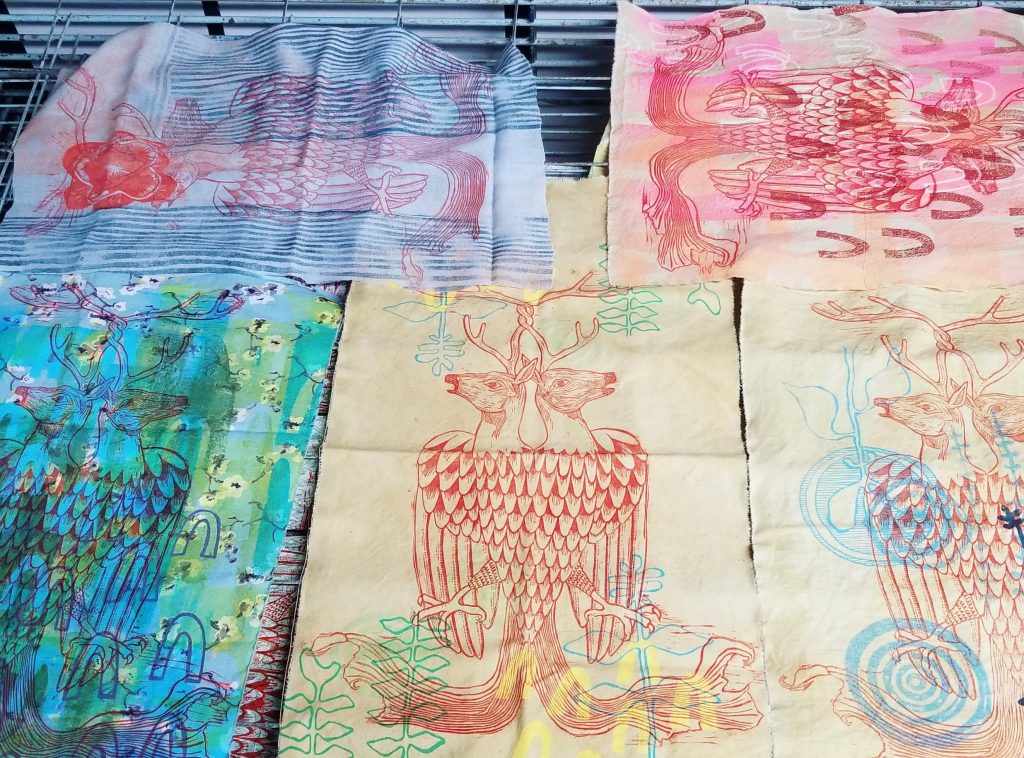
It’s been difficult to muster up any motivation to work in the studio with all the summer art fairs cancelled. I feel fortunate that I made the decision to close my brick-and-mortar shop just before Coronavirus put a stop to normalcy, but it doesn’t feel like there’s any urgency to make new work. These prints are stalled in the early colour stages with about half of their screenprinted colour layers printed, still a ways from having their linocut key layers added. In the meantime, I printed them in red on some previously printed fabrics. Thinking about a bright, blinding quilt.

_IMG_000000_000000

IMG_20210101_111453090